Laser Infrastructure: PHIN Drive Beam
The goal of the CLIC drive laser research is to investigate the generation of powerful UV light (by means of fourth harmonic generation of a 500 MHz Nd:YLF laser) that is proposed for PHIN, the drive electron beam project of the CLIC photoinjector facility. The current work involves the study of the quality of the 2nd and 4th harmonic generation of long pulse trains (up to 140 µs) at 500 MHz repetition rate in order to fulfill the CLIC project requirements which are summarized as below:
Parameter | CLICRequirement |
|---|---|
Trainduration | 140µs |
Repetitionrate | 500MHz |
Pulseduration | 8-10ps |
Trainrepetitionrate | 50Hz |
UVpulseenergy | 2µJ/pulse |
UVtrainaveragepower | 1kW |
SHpulseenergy | 5.7µJ/pulse |
SHtrainaveragepower | 2.8kW |
IRpulseenergy | 13µJ/pulse |
IEtrainaveragepower | 6kW |
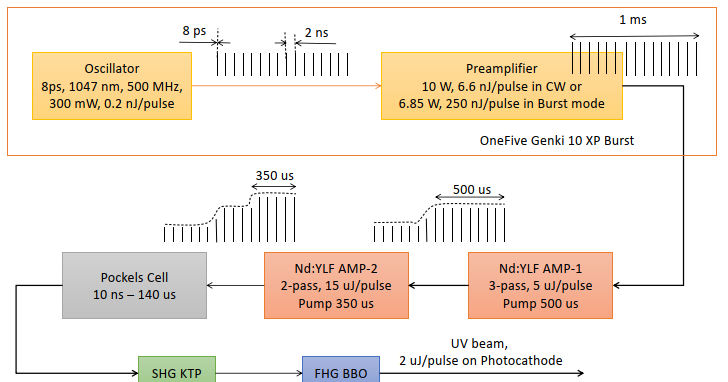
The laser system’s schematic is shown in Fig. 1. A continuous train of pulses with a duration of 8.4 ps centered at 1047 nm at a repetition rate of 500 MHz is utilized as seed. The front-end laser is a Genki-10 XP burst, which contains locking electronics to the RF signal at CLEAR, fiber oscillator, and amplifier (Lydya). The main parameters of the front-end laser system are shown in Table 2.
| Parameter | Value |
|---|---|
| Repetition rate | 500 MHz |
| Burst repetition rate | 0-50 Hz |
| Burst duration | 0-1.1 ms |
| Pulse duration | 8.4 ps |
| Avg. power in a burst | 124.6 W |
| Max. CW output power | 12.05 W |
| Center wavelength | 1047.044 nm |
| Bandwidth @ 10 W CW | 0.219 nm |
| Center wavelength @ 100 W burst | 1046.575 nm |
| Bandwidth @ 100 W burst | 0.488 nm |
| M2 at 10 W CW | 1.05-1.08 |
| M2 at 100 W burst | 1.09-1.14 |
| PER @ 10 W CW or 100 W burst | 24.2-25 dB |